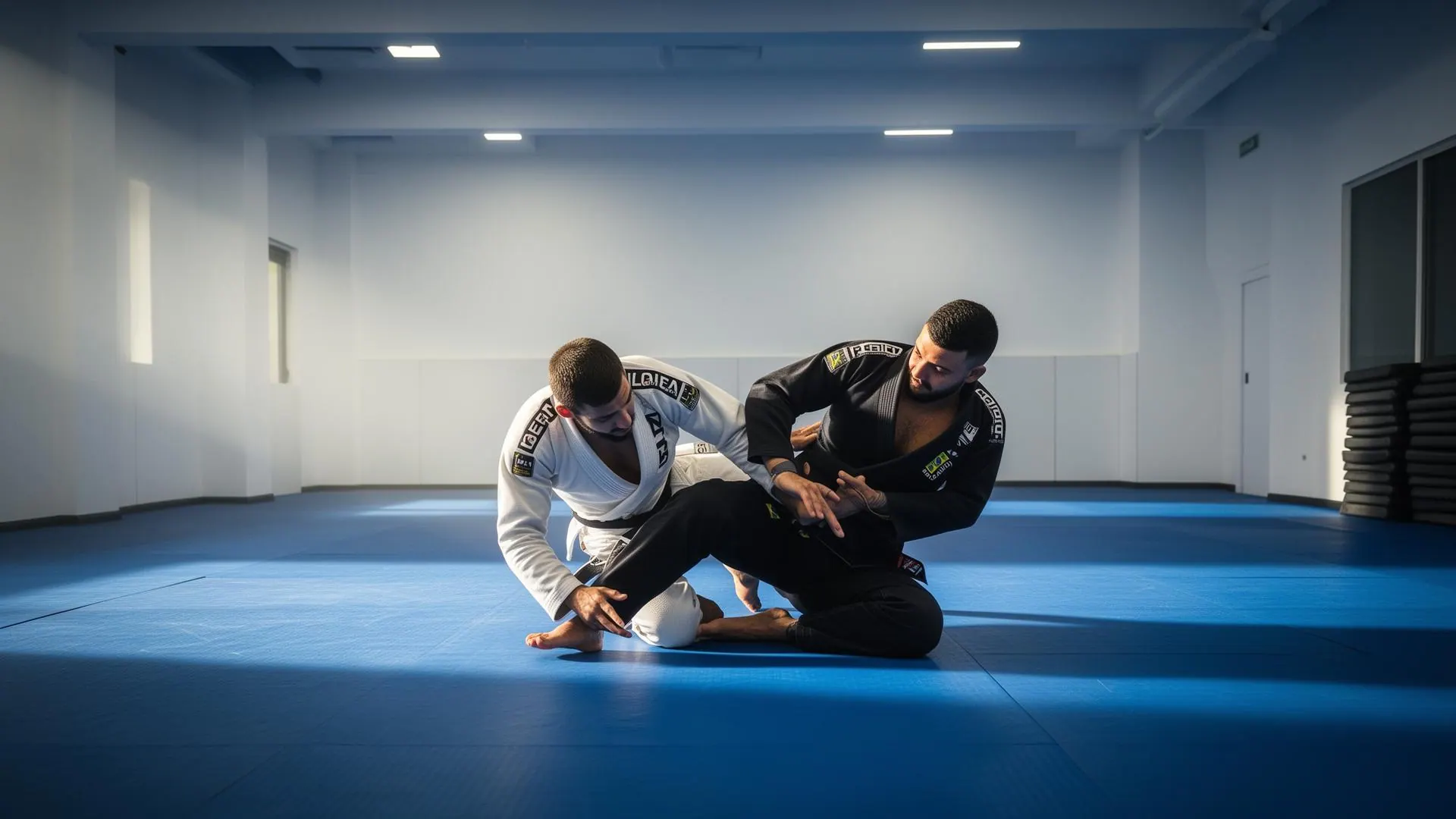
BJJ Belt Progression
How Long Does It Take to Get a Blue Belt in BJJ?
Most students earn a blue belt in 1–3 years. But that number hides the real story — the one about consistency, ego, and what it actually takes to earn it. Here's the honest answer.
The first question almost every new BJJ student eventually Googles: how long until I get my blue belt? It's a fair question — and the honest answer is: it depends. But not on talent. It depends almost entirely on your commitment to showing up.
Quick Answer
Most adult students training 2–4 times per week earn a blue belt in 1.5 to 3 years. Students with a wrestling or judo background often get there faster. Students who train infrequently or take long breaks can take 4+ years — or never get there at all.
Why the White Belt Phase Is Harder Than You Think
White belt is where most people quit. That's not an exaggeration — the majority of people who walk onto the mats for the first time never make it to blue. They tap out of the sport before they tap out on the mat.
It's not because BJJ is brutally hard on the body (though it's a real workout). It's because being a beginner at something as physical and technical as jiu-jitsu challenges your ego in a way almost nothing else does. You will get submitted by people who weigh less than you. You will feel completely lost for months. You will have days where the techniques feel like they belong to someone else's body.
This is why the blue belt is sometimes called the hardest belt to earn — not because the technical bar is the highest (black belt is far more demanding), but because you have to survive a long phase of feeling like a beginner before you can feel like a practitioner.
What BJJ Instructors Are Actually Looking For
There is no universal standard for a blue belt promotion. Your instructor decides — and every instructor has their own criteria. But broadly speaking, a white belt ready for blue should demonstrate:
- The ability to survive and escape from bad positions (mount, back, side control)
- Basic guard work — maintaining, sweeping, and submitting from guard
- Functional guard passing against other white belts
- At least 4–5 submissions they can finish consistently
- Awareness of transitions — not just individual techniques
- Good mat etiquette, attitude, and the ability to train partners without injuring them
Notice that the last point — attitude and etiquette — is on this list. Most instructors won't promote someone who is technically solid but dangerous, reckless, or disrespectful on the mat. The belt represents you as a practitioner and as a person.
Instructor Insight
At Mission Jiu Jitsu, promotions are based on what you demonstrate in class — not how long you've been training. Show up, work hard, and be a good training partner. The belt follows naturally.
The Real Variables That Speed Up (or Slow Down) Your Progress
Training Frequency
This is the biggest factor, by far. If you train twice a week, expect 2–3 years. If you train four times a week, 12–18 months is realistic. Going more than five times per week early on often backfires — injury and burnout become the enemy of consistency.
Prior Grappling Experience
Wrestlers and judoka often adapt quickly because they already understand base, weight distribution, and the feeling of live grappling. A former Division I wrestler may earn a blue belt in six to nine months. A complete beginner with zero grappling background should expect longer — and that's perfectly fine.
Your Body and Age
Starting BJJ in your 30s or 40s is common and achievable — we cover this in depth in our Starting BJJ After 40 guide. Older athletes often absorb technique more thoughtfully, even if their recovery takes a bit longer. Age doesn't disqualify you from progress; it just means training smart matters more.
Quality of Training Environment
Where you train matters enormously. A school with a structured curriculum, experienced upper belts who will roll with you properly, and a coach invested in your development will accelerate you faster than random open mats with no guidance. Not all hours on the mat are equal.
BJJ Belt Timeline at a Glance
| Belt | Duration | Classes / Wk | Mat Hours |
|---|---|---|---|
| White → Blue | 1–3 years | 2–4× | 200–500 hrs |
| Blue → Purple | 2–4 years | 3–5× | 500–900 hrs |
| Purple → Brown | 1.5–3 years | 3–5× | 300–600 hrs |
| Brown → Black | 1–3 years | 4–6× | 300–600 hrs |
These are averages, not rules. The IBJJF provides minimum age and time-in-rank requirements for black belt, but below black belt, promotions are entirely up to your instructor.
The Mental Trap: Chasing the Belt
The most counterproductive thing a white belt can do is obsess over the belt itself. When your goal becomes "earn the promotion" rather than "get better at jiu-jitsu," you start gaming the system — avoiding hard rounds, sandbagging in sparring, performing for the instructor.
Experienced instructors see this immediately. The students who get promoted fastest are almost always the ones who stopped thinking about promotion entirely. They came to class. They drilled. They showed up on the hard days. They asked good questions. They were generous training partners.
The Mindset Shift
Don't train to earn your blue belt. Train to be the best white belt you can be. If you do that consistently, the belt becomes a formality — a moment your instructor pauses to acknowledge what you've already become.
What Happens After Blue Belt
Getting your blue belt opens a new challenge: the blue belt slump. Many students quit shortly after promotion, partly because the motivating goal is gone and partly because blue belts are expected to perform at a higher level.
Our advice: set a new goal the week after promotion. Sign up for a competition. Pick a submission system to master. Become someone the new white belts look up to. The belt is not the destination — it's a door into a deeper part of the journey.
Checkout our Friends Elite Sports for BJJ Gi, Kids Gi and Premium Gi
Frequently Asked Questions
How long does it take to get a blue belt in BJJ?
Most students receive a blue belt after 1–3 years of consistent training, typically 2–4 classes per week. There is no set number of classes required — progression is based on demonstrated skill and your instructor's assessment of your readiness.
What do I need to know to get a blue belt in BJJ?
A blue belt should be comfortable surviving against beginners, understand basic guard passing and sweeping, know a handful of reliable submissions from dominant positions, and demonstrate strong mat etiquette and a positive attitude.
Is the blue belt the hardest belt to get in BJJ?
Many practitioners say yes — not because it's the most technically demanding, but because it requires breaking through the difficult beginner phase. The white-to-blue transition demands consistency through frustration and uncertainty.
How many classes per week should I take to get my blue belt faster?
Three to four classes per week is the sweet spot for most adult beginners. Training more accelerates progress but increases injury risk. Fewer than two classes weekly tends to slow retention of technical detail.
Can I get a BJJ blue belt in one year?
Yes — some students earn a blue belt in under a year, usually those with prior grappling experience or who train four to five times per week. For most adults starting with no grappling background, 18 months is a realistic target.